Strengthening Secondary Maths: Reflections from my first weeks as Director for Secondary Mathematics
Nicola Trubridge reflects on key issues in secondary maths, including what the EEF’s new research study on student grouping reveals about what matters most for students
22/05/2026
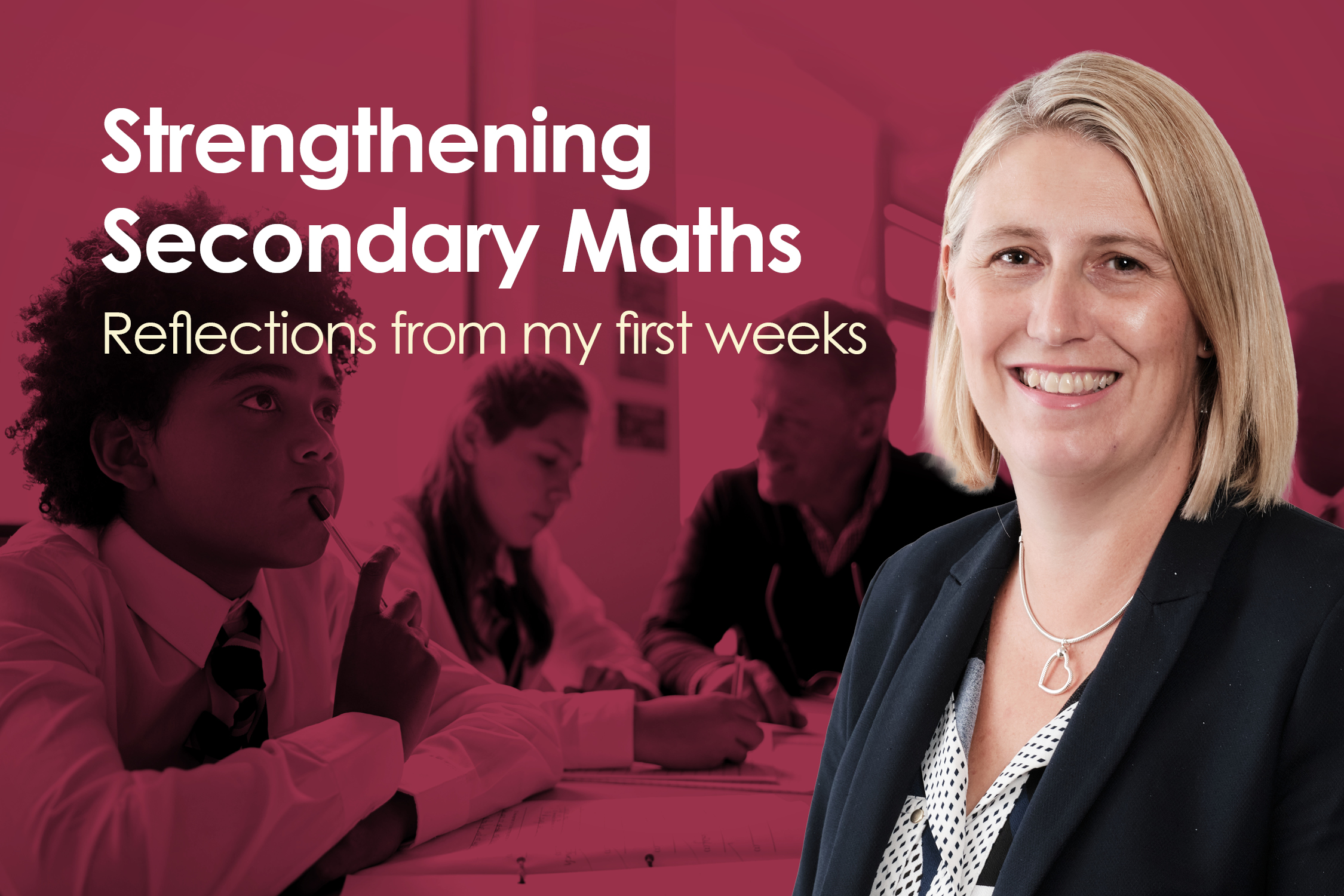
Stepping into the role of the NCETM’s Director for Secondary Mathematics has given me the privilege of seeing, up close, the commitment and expertise that characterise secondary maths teaching across the country. In my first few weeks, I’ve spoken with teachers, heads of department, Maths Hub Leads and Mastery Specialists, and a consistent message has emerged: secondary maths is at a pivotal moment.
There is a shared determination across schools to ensure that every young person, regardless of background, prior attainment or postcode, experiences a coherent, connected and empowering maths education.
I’m especially struck by how strongly teachers want to build on the principles of teaching for mastery as a long‑term approach to deepening mathematical understanding for all, not as an imposed model but as a ground-up development, informed by the NCETM’s The Essence of Mathematics Teaching for Mastery. I’ve seen departments working collaboratively to refine curriculum sequencing, strengthen mathematical talk and ensure that representations and structures are used coherently across Key Stages 3 and 4. These conversations are thoughtful, ambitious, suited to the context and grounded in what we know works.
Transition is a recurring theme. The move from primary to secondary remains critical, and work happening through Years 5–8 Continuity and the Securing Foundations at Year 7 Programme shows what is possible when we focus on coherence rather than acceleration. When students are given time to build and strengthen core ideas, their confidence grows, and so does their capacity to engage with more complex mathematics later.
Another area of focus is assessment, especially pertinent as this years’ maths GCSEs are upon us. Teachers tell us they want assessment to illuminate learning, not distort it. The Curriculum and Assessment Reform is a real opportunity to align what we value in maths with what we measure. This alignment is essential if we want students to develop secure understanding rather than short‑term procedural recall.
Reflecting on the EEF Student Grouping Study for maths
The recent publication of the EEF’s Student Grouping Study has prompted important conversations. The study explores differences in maths attainment outcomes for students taught in mixed prior-attainment classes compared with those taught in sets in Years 7 and 8. As with any research in this area, the findings have generated strong reactions and, in some cases, headlines that risk oversimplifying a complex issue.
This new research adds useful evidence to an area where views are often strongly held. Crucially, it reinforces the importance of looking beyond the question of whether students are taught in sets or mixed-attainment classes, and instead focusing on what students experience in those classrooms. The NCETM’s advice from 2018 still holds true: decisions about grouping are for schools to make, based on their students, staffing and context. There is no single model that will suit every school.
Whatever approach is taken, decisions affecting access to GCSE content must be made carefully and at the right time. Where schools group by attainment, movement between groups must remain possible, with high expectations for all. Early decisions about tier of entry carry significant risk if they limit access to the full curriculum, a concern highlighted in Ofsted’s 2023 mathematics subject report, Coordinating mathematical success, which cautioned against practices that unnecessarily restrict students’ opportunities to achieve the highest outcomes.
All students should be supported to think, reason and solve problems, and to engage with the same underlying mathematical ideas, regardless of how they are grouped. High-quality teaching, a coherent curriculum, and a belief that all students can learn mathematics deeply are far more consequential than the grouping structure alone.
Colleagues across the Maths Hubs Network have already offered thoughtful reflections. Some have highlighted that the most useful takeaway from the study is that it is not about ’set or mixed attainment’, but about the quality of teaching, the support available to staff, the design of the curriculum, and the flexibility of movement between groups. Others have cautioned against ‘lethal mutations’, referring to the risk that schools respond to headlines rather than the full report, or that they attempt to solve the wrong problems.
It is also important to recognise what the study does not tell us: how students were taught, what progress looked like in practice, what teachers believed about their learners, or what professional development was available. These unknowns matter, because they shape the lived experience of students far more than the label attached to their class.
As we continue to digest the findings, our focus will remain on supporting schools to make thoughtful, context‑sensitive decisions that keep students’ opportunities open for as long as possible. We will discuss the study in greater depth with secondary subject leaders and secondary Maths Hubs colleagues over the coming months, exploring the implications together.
Looking ahead
I’m looking forward to working closely with expert colleagues across the Maths Hubs Network and beyond, as we all work to lay the foundations for the coming changes in the curriculum. The expertise within the system is extraordinary. My role is to help connect and lead that expertise, to ensure ongoing improvements to maths education for all students.
Secondary maths education is at its strongest when we work collectively, sharing practice, interrogating evidence, and keeping our focus firmly on what helps students learn well. I’m excited to contribute to that shared endeavour, and to continue learning from the teachers and leaders who make it possible.